
Caches, browser histories, and leftover temporary files pile up faster than most Ubuntu desktops reveal. If you want to install BleachBit on Ubuntu to reclaim disk space, clear browser junk, and wipe traces of older files, Ubuntu already packages it in the archive and Flathub offers a newer Flatpak build.
The APT package fits most desktops because it stays in Ubuntu’s normal update flow, while the Flatpak build moves faster and keeps a tighter sandbox. You can install BleachBit from a terminal on Ubuntu 26.04, 24.04, and 22.04, but the application itself still needs an active graphical session when you launch it.
Install BleachBit on Ubuntu
Two installation paths make sense on Ubuntu. APT gives you the distro-managed package, and Flatpak pulls the newer upstream build from Flathub.
| Method | Channel | Version | Updates | Best For |
|---|---|---|---|---|
| APT Package Manager | Ubuntu Universe | Distribution default | Automatic via apt upgrade | Most users who want Ubuntu-managed updates |
| Flatpak | Flathub | Latest stable | Manual via flatpak update | Users who want newer releases or extra isolation |
APT is the better default on Ubuntu because it stays in the normal package workflow and matches each LTS release. Flatpak makes more sense when you want newer BleachBit builds than the Ubuntu archive currently ships, and Flathub is already tracking BleachBit v5.1.1.
These steps support Ubuntu 26.04, 24.04, and 22.04. The same APT and Flatpak commands work across the supported LTS set unless a version-specific note says otherwise.
You can install either method from a terminal, but BleachBit itself is still a desktop application and needs a graphical session when you launch it.
Update Ubuntu Before Installing BleachBit
Refresh the package index and apply pending upgrades first so BleachBit pulls against current system libraries.
sudo apt update && sudo apt upgradeThese commands use
sudofor tasks that need root privileges. If your account does not have sudo access yet, follow the guide to add a new user to sudoers on Ubuntu before continuing.
Install BleachBit from Ubuntu Repositories
The native package is the simplest path on Ubuntu. BleachBit lives in the Universe component on all supported LTS releases, so if APT cannot find the package, first enable Universe and Multiverse in Ubuntu.
sudo apt install bleachbit -yVerify the APT BleachBit Installation
Use APT’s package metadata for the cleanest verification check. This confirms that the package is installed without relying on a GUI-aware version command in a headless shell.
apt-cache policy bleachbitExpected output on Ubuntu 24.04:
bleachbit:
  Installed: 4.6.0-3
  Candidate: 4.6.0-3
  Version table:
 *** 4.6.0-3 500
        500 http://au.archive.ubuntu.com/ubuntu noble/universe amd64 Packages
        100 /var/lib/dpkg/status
Ubuntu 26.04 shows version 5.0.2-1, and Ubuntu 22.04 shows 4.4.2-1. If Installed and Candidate match for your release, the package is ready.
Enable Flathub for BleachBit
Flathub is the source for the Flatpak build, so add the remote first if your system does not already have it configured.
Flatpak is not pre-installed on Ubuntu. If you have not set it up yet, follow the guide to install Flatpak on Ubuntu before continuing.
sudo flatpak remote-add --if-not-exists flathub https://dl.flathub.org/repo/flathub.flatpakrepoConfirm that Flathub is available at system scope before the install step.
flatpak remotes --columns=name,options | grep "^flathub"The grep command in Linux keeps the remotes output focused on the Flathub entry instead of printing every configured source.
Relevant output includes a firefox row like this:
flathub system
Install the BleachBit Flatpak
BleachBit’s Flathub app ID is org.bleachbit.BleachBit. Because the Flathub remote was added with sudo, keep the install at the same system scope.
sudo flatpak install flathub org.bleachbit.BleachBit -yVerify the Flatpak BleachBit Installation
Flatpak reports the installed app metadata without launching the GUI, so it is the cleanest way to verify the Flathub method.
flatpak info org.bleachbit.BleachBitExpected output:
BleachBit - Free space and maintain privacy

          ID: org.bleachbit.BleachBit
         Ref: app/org.bleachbit.BleachBit/x86_64/stable
        Arch: x86_64
      Branch: stable
     Version: v5.1.1
     License: GPL-3.0
      Origin: flathub
  Collection: org.flathub.Stable
Installation: system
   Installed: 8.6 MB
     Runtime: org.gnome.Platform/x86_64/49
Launch BleachBit on Ubuntu
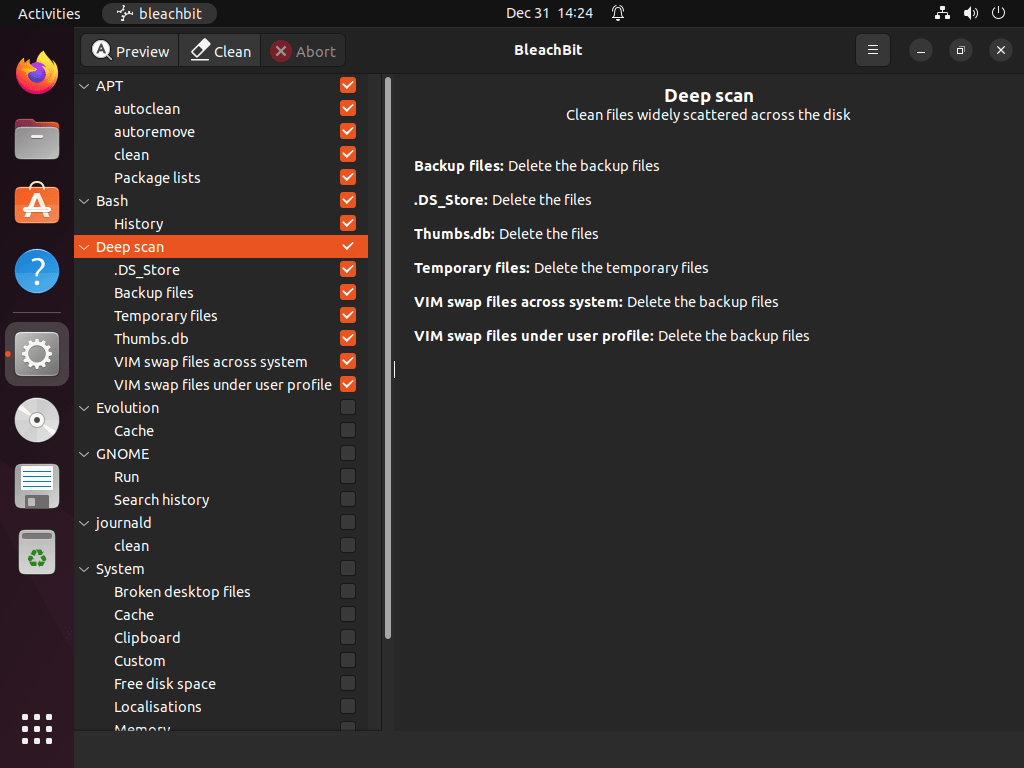
BleachBit can open as a normal desktop application, and it also exposes command-line options for listing, previewing, and running cleaners. The GUI needs a graphical session, while the CLI can still be useful from a terminal.
Open the BleachBit Graphical App from the Terminal
Use the command that matches the method you installed.
bleachbitflatpak run org.bleachbit.BleachBitUse BleachBit from the Command Line
BleachBit includes a real CLI, so you can inspect available cleaners before you run a preview or a cleanup job.
bleachbit --list-cleanersExample output from a headless shell:
adobe_reader.cache
adobe_reader.mru
adobe_reader.tmp
amsn.cache
amsn.chat_logs
amule.backup
amule.known_clients
apt.autoclean
apt.autoremove
apt.clean
Headless shells can prepend the same GDK warning shown later in the troubleshooting section before this cleaner list. Either way, the CLI options are available through bleachbit --help, including --preview, --clean, and --shred.
Open BleachBit from the Ubuntu Applications Menu
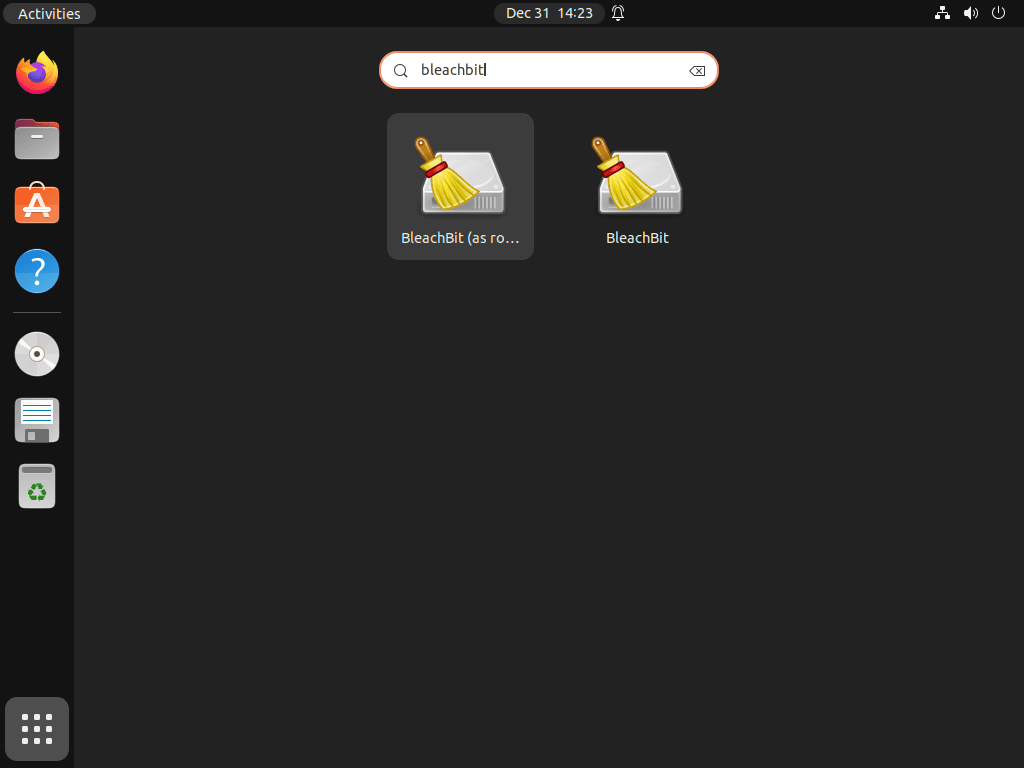
Open the applications menu or Activities overview, search for BleachBit, and start the app from there if you prefer a normal desktop launch.
Compare BleachBit Versions on Ubuntu
Ubuntu package versions vary more by release than the Flatpak build does, so this reference table helps when you care about feature age before you choose a method.
| Ubuntu Release | APT Package | Flatpak | Notes |
|---|---|---|---|
| Ubuntu 26.04 LTS (Resolute) | BleachBit 5.0.x | BleachBit v5.1.1 | Smallest gap between Ubuntu and Flathub |
| Ubuntu 24.04 LTS (Noble) | BleachBit 4.6.x | BleachBit v5.1.1 | Good default package, newer Flatpak available |
| Ubuntu 22.04 LTS (Jammy) | BleachBit 4.4.x | BleachBit v5.1.1 | Largest version gap between APT and Flatpak |
Update or Remove BleachBit on Ubuntu
Updates and removal stay simple once you know which package format you used. Keep the commands aligned with the same APT or Flatpak method you installed earlier.
Update BleachBit on Ubuntu
Update only the native package with APT if you installed BleachBit from Ubuntu’s repositories.
sudo apt install --only-upgrade bleachbitUpdate only the Flatpak app if you installed BleachBit through Flathub.
sudo flatpak update org.bleachbit.BleachBit -yAfter either update path, rerun the matching verification command from the installation section to confirm the installed version and source.
Remove BleachBit from Ubuntu
Remove the APT package and the Flatpak build separately, because each format keeps its own package records and cleanup behavior.
Remove the APT BleachBit Package
Purge the native package first if you installed BleachBit from Ubuntu’s repositories.
sudo apt remove --purge -y bleachbitIf APT also offers unused dependencies afterward, review that list before you confirm the cleanup.
sudo apt autoremoveVerify that the package itself is gone while the Ubuntu repository still provides the normal candidate for your release.
apt-cache policy bleachbitExpected output on Ubuntu 24.04 after removal:
bleachbit:
  Installed: (none)
  Candidate: 4.6.0-3
  Version table:
    4.6.0-3 500
      500 http://au.archive.ubuntu.com/ubuntu noble/universe amd64 Packages
Ubuntu 26.04 and 22.04 show different candidate versions, but Installed: (none) is the key state to check after the purge.
Remove the BleachBit Flatpak
Remove the Flatpak app with the same system scope used during installation.
sudo flatpak remove -y org.bleachbit.BleachBitCheck that the Flatpak app no longer appears in the installed app list.
flatpak list --app | grep -F org.bleachbit.BleachBit || echo "not installed"Expected output:
not installed
Remove Leftover BleachBit Settings if Needed
BleachBit can leave user settings behind after package removal. Native installs commonly keep ~/.config/bleachbit, while the Flatpak build uses ~/.var/app/org.bleachbit.BleachBit only after it has actually created sandbox data.
Delete these paths only if you want a full cleanup with no saved preferences left behind.
find "$HOME" -maxdepth 3 \( -path "$HOME/.config/bleachbit" -o -path "$HOME/.var/app/org.bleachbit.BleachBit" \) -printDelete only the paths that the find command prints.
rm -rf ~/.config/bleachbit ~/.var/app/org.bleachbit.BleachBitTroubleshoot BleachBit on Ubuntu
The most common Ubuntu-specific issues come from Firefox’s Snap layout, root-mode launches, and headless terminals that do not have an active display available.
Fix Firefox Snap Cache Detection in BleachBit
Ubuntu ships Firefox as a Snap on current desktop installs, and that changes where BleachBit needs to look for browser cache files.
snap list firefoxExpected output:
Name     Version    Rev   Publisher
firefox  147.0.2-1  7719  mozilla**
If Firefox appears in that list, BleachBit may need the Snap cache path instead of the older ~/.mozilla/ layout.
~/snap/firefox/common/.cache/
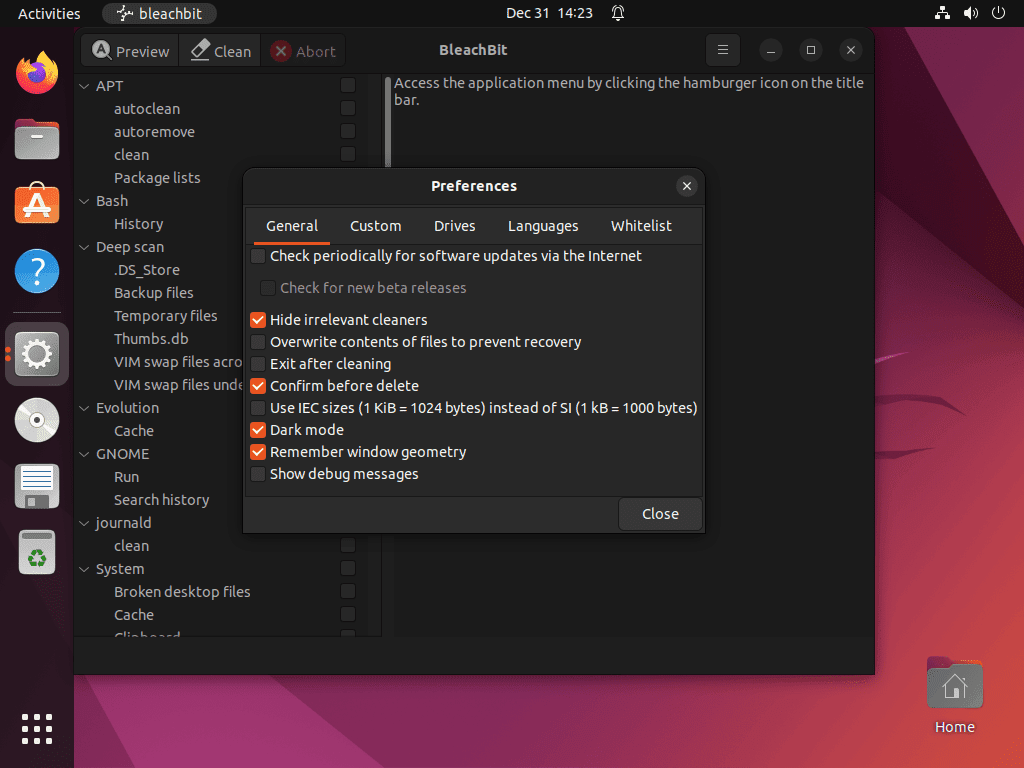
Use BleachBit’s Deep Scan preferences to add that directory, or remove Firefox Snap from Ubuntu if you want to move back to a non-Snap browser workflow.
Run BleachBit as Root on Ubuntu
BleachBit’s root mode exposes cleaners for system caches, logs, and other locations that a normal user account cannot edit.
pkexec bleachbitIf you only need to inspect the available command-line options first, run sudo bleachbit --help in a terminal. The full graphical root session still needs a desktop environment.
Handle BleachBit Version Warnings in Headless Sessions
BleachBit can print GDK warnings over SSH or other headless shells because parts of the program still probe for a graphical display before they print version or cleaner information.
bleachbit --versionExample output from Ubuntu 24.04 over SSH:
(bleachbit:21323): Gdk-CRITICAL **: 15:08:07.580: gdk_screen_get_root_window: assertion 'GDK_IS_SCREEN (screen)' failed

BleachBit version 4.6.0
Copyright (C) 2008-2023 Andrew Ziem.  All rights reserved.
License GPLv3+: GNU GPL version 3 or later <http://gnu.org/licenses/gpl.html>.
This is free software: you are free to change and redistribute it.
There is NO WARRANTY, to the extent permitted by law.
The warning is noisy, but the version output still works. When you want a headless-safe install check, use apt-cache policy bleachbit or flatpak info org.bleachbit.BleachBit instead.
BleachBit on Ubuntu FAQ
Yes. Ubuntu packages BleachBit in the Universe component on Ubuntu 26.04, 24.04, and 22.04. The package version changes by release, so Ubuntu 26.04 carries a newer branch than Ubuntu 24.04 or 22.04.
Use the APT package when you want Ubuntu-managed updates and the normal system package workflow. Use the Flatpak build when you want a newer BleachBit release from Flathub or prefer extra isolation around the application.
Yes. BleachBit exposes CLI options such as --list-cleaners, --preview, --clean, and --shred. The graphical app is still the main interface, and headless shells can prepend GDK warnings before the CLI output appears.
The Flathub app ID is org.bleachbit.BleachBit. Use that identifier for flatpak install, flatpak info, flatpak update, and flatpak remove commands on Ubuntu.
Conclusion
BleachBit is ready on Ubuntu for clearing cache, temporary files, and other leftover clutter whether you stayed with the distro package or moved to the newer Flathub build. If you want a second desktop cleanup tool for old package caches and stale kernels, you can also install Ubuntu Cleaner on Ubuntu.

Formatting tips for your comment
You can use basic HTML to format your comment. Useful tags currently allowed:
<code>command</code>command<strong>bold</strong><em>italic</em><blockquote>quote</blockquote>